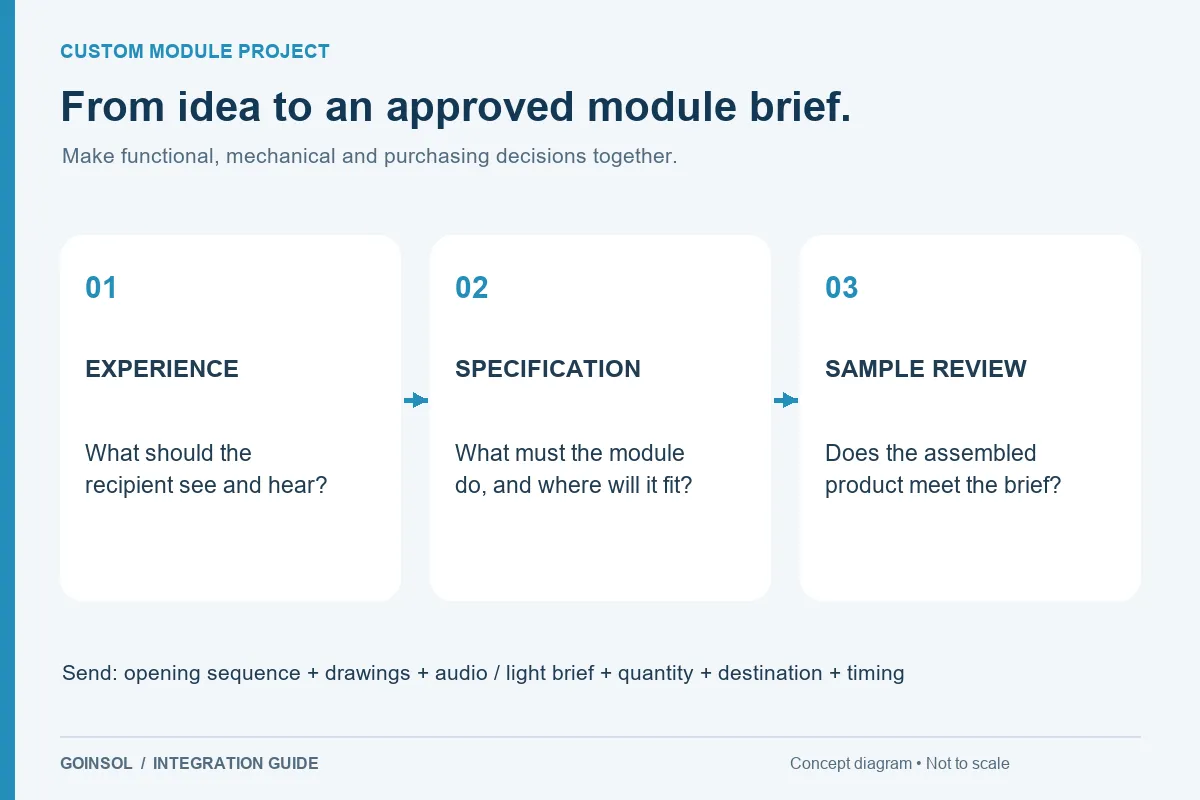
Define who records the message, how it is replayed and how the product prevents accidental overwrite.
A voice recording module lets a user capture a message and play it back through a speaker. It differs from a pre-programmed sound module, where the audio is prepared before use. For a personal gift, the recording workflow is part of the product: the giver should understand how to leave the message, and the recipient should be able to replay it without accidentally replacing it. These interactions deserve as much attention as the board dimensions.
1. Decide who creates the message
There are several distinct projects hidden inside the word recordable. A purchaser may record once before giving the gift. A recipient may change the message repeatedly. A production team may load a different digital file into each unit. A built-in microphone and a digital upload interface are not interchangeable. Tell GOINSOL who handles the content, where they do it and whether any computer or other tool is available. Upload capability should be confirmed for the selected module rather than assumed.
2. Describe the complete control sequence
Specify how recording begins and ends, how the user knows recording is active, and what happens at the maximum recording time. Decide whether recording requires holding a button or a deliberate sequence. Define playback separately: single press, playback to completion, interruption and repeated pressing. A short instruction next to an accessible control may be more useful than a complicated sequence that fits on a smaller board. Consider the intended users and how they will hold the product.
3. Protect the message deliberately
For a keepsake, accidental erasure is an important design risk. The record control could be less exposed than the play control, or the workflow could include a deliberate action before replacement. The appropriate protection is agreed for the design; it should not be described as permanent storage or a record lock without testing. Confirm whether the saved message survives battery removal and replacement, and include that check in sample approval. Power loss while recording may behave differently from power loss after saving.
4. Make the microphone usable
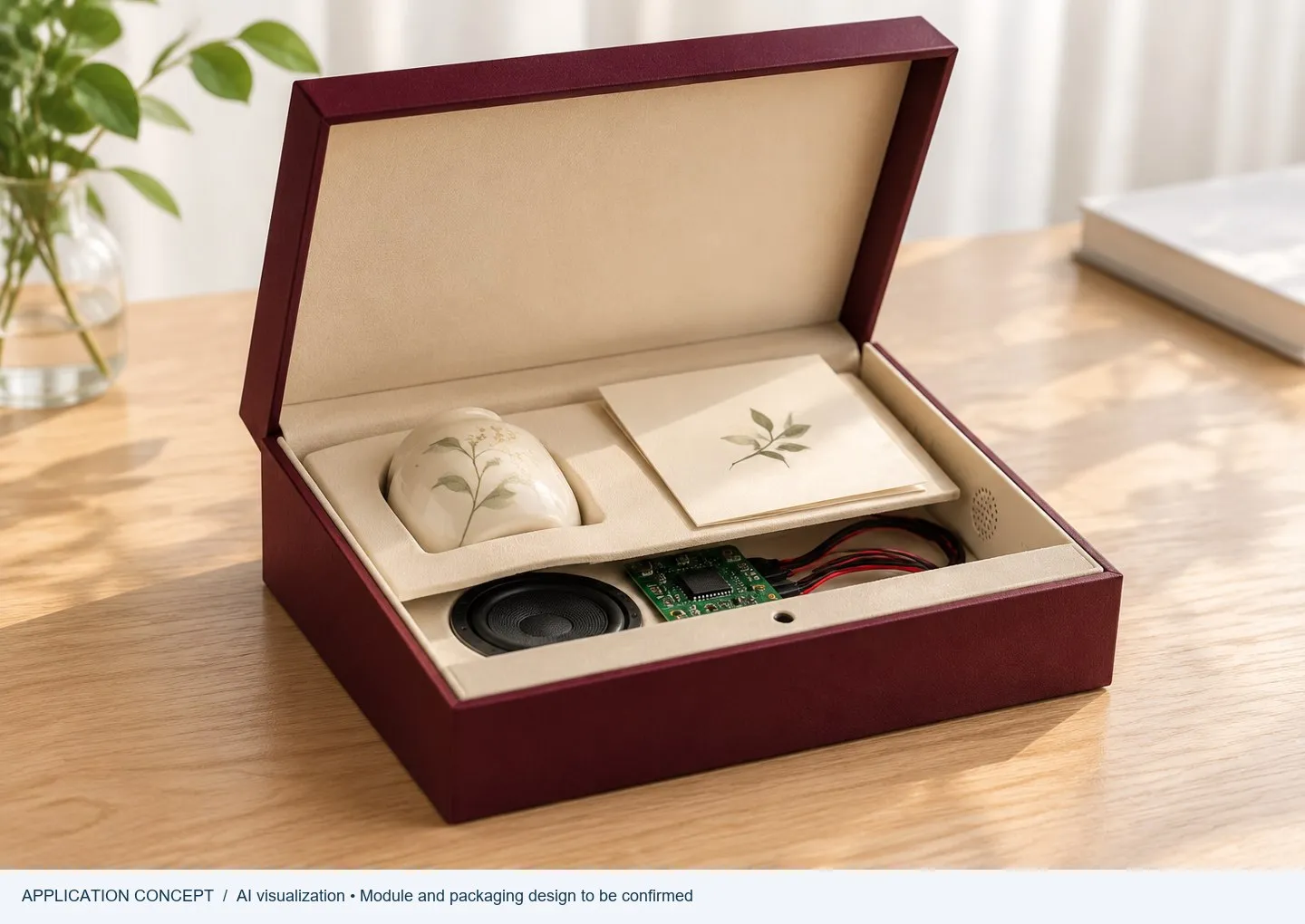
A microphone buried under dense fabric or foam may produce a muffled message. Mark the microphone opening, likely speaking distance and the direction in which the user speaks. Evaluate the assembled product in a quiet room and in the normal recording environment. Handling noise, fingers covering the opening and nearby electronics can affect the result. A useful recording test uses the same voice and distance for each revision so the comparison is meaningful.
5. Balance duration, clarity and power
Recording duration, audio quality, storage and power must be considered together. Longer duration alone is not a complete specification. Provide a representative spoken message and explain which words must remain clear. Specify the expected number of recordings and replays, storage period and playback environment. Test the speaker through the final enclosure; the recording may be clear electronically yet difficult to understand through the chosen outlet or insert.
6. Test errors as well as the intended sequence
Check a short press, a long press, repeated presses, recording until full, playback after a restart and any overwrite procedure. Verify that the message plays clearly at a realistic listening distance and that the controls remain accessible after the gift is packed. Ask a person unfamiliar with the prototype to use the instructions. Their hesitation can reveal a control or labeling problem that the project team has learned to work around.
What to send GOINSOL
Provide the user journey, target recording duration, overwrite rules, required feedback, control positions, microphone and speaker openings, available depth, power preference, storage assumptions and expected quantity. Photos of the product and a short example message help make the requirements concrete. The recording method, memory behavior, component layout and commercial terms are confirmed for the proposed design.
DISCUSS YOUR APPLICATION